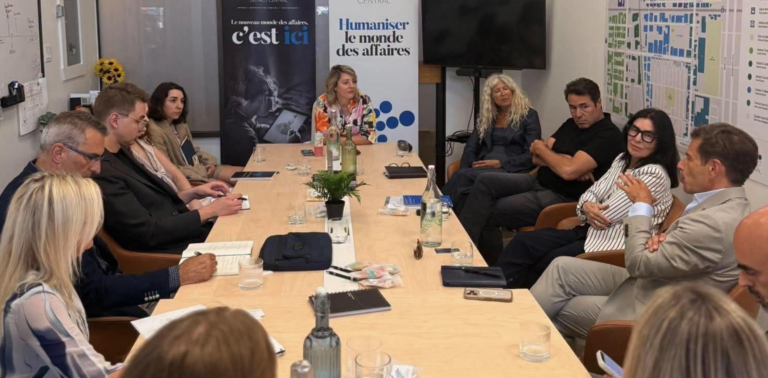
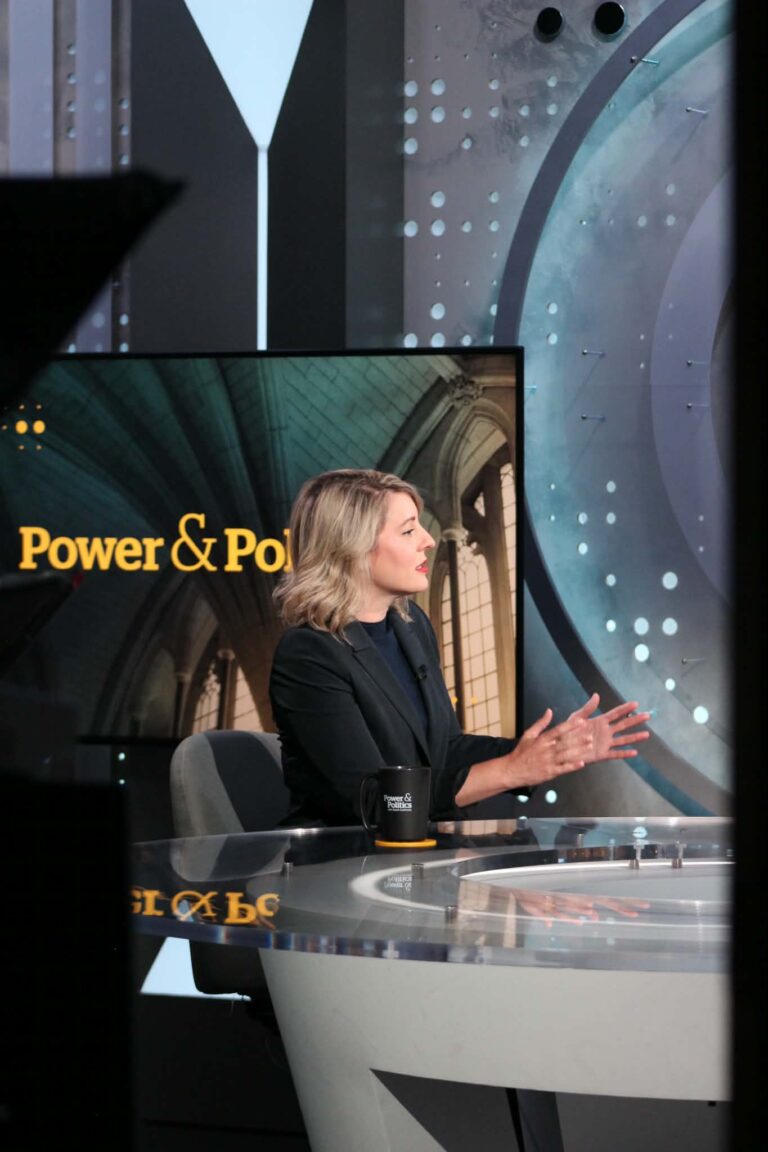
Minister Joly advances the Canadian aerospace industry at the Farnborough International Airshow in the United Kingdom
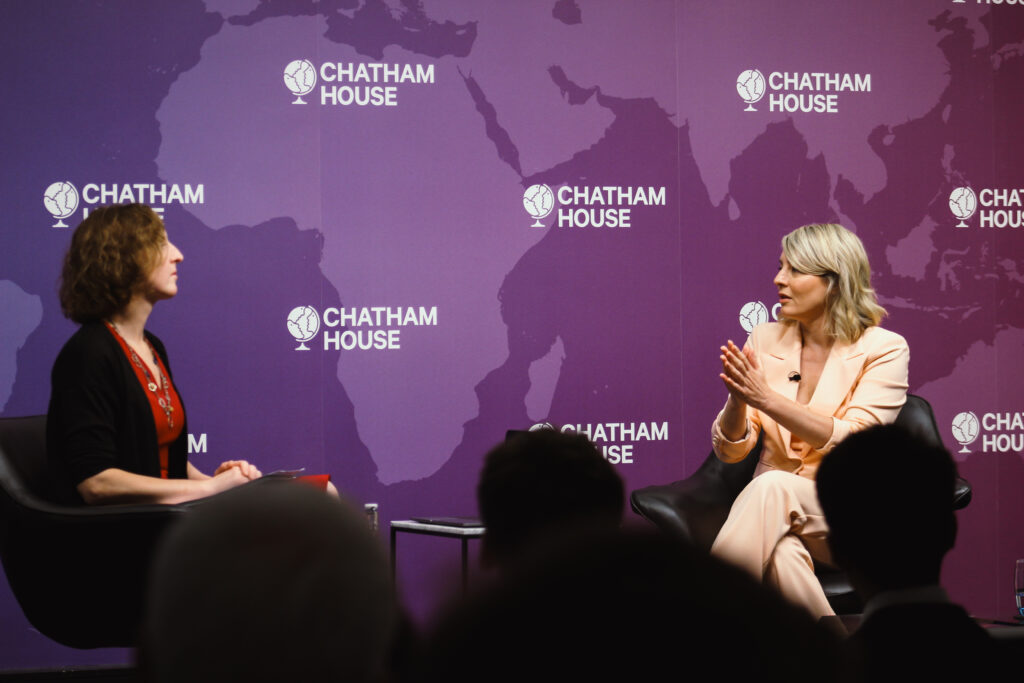
July 23, 2026 – Farnborough, United Kingdom
” I’m really happy to be back in London. It’s a city I got to know as the former foreign minister, a role which allowed me to be here quite often. I also served alongside four different foreign ministers from the UK: Liz Truss, James Cleverly, David Cameron, and David Lammy. As previously mentioned, I’m a graduate of Brasenose College, Oxford, where I studied from 2002 to 2003 when the UK was still part of the EU, and the EU was talking about creating its own constitution.
I will also be forever grateful to the British people because I’m a Chevening scholar, and I was able to get the chance to study abroad, a little francophone girl from Montreal. So, thank you again.
Today, I’m here in the context of the Farnborough Airshow, which is an important airshow, leading the Canadian aerospace delegation. This is very much full circle for me. The reason I say that is I was appointed Minister of Industry at a time of a trade war that now allows me to focus on the consequences, whereas in myprevious term as Foreign Minister I used to work on the causes of the trade war.
Being in charge of the front lines, including the steel and aluminum sector, the auto sector, as well as manyother sectors, which are particularly hit with the recent tariffs. And so I come to the table with not only a deep understanding of geopolitics, but a responsibility of protecting and creating thousands of jobs in Canada at atime where we are so deeply integrated in the North American economy and have had, for too long, a dependency on the U.S. market.
I take this duty of serving my country extremely seriously because so much is at stake. The team and I are acting with urgency because we know time is of the essence, and both the government and our industry are working as one team Canada.
The aerospace sector is a perfect example: Canada has the fourth-largest aerospace sector in the world. We have great homegrown Canadian companies such as Bombardier, CAE, and De Havilland Canada. We also have foreign companies that have a very strong manufacturing industrial footprint in our country, including Bell Textron, Pratt & Whitney, and Mitsubishi Heavy Industries.
Many of these companies’ history dates back to the Second World War, when we started from scratch and created an aerospace sector to support, of course, Canadian soldiers, but also the British forces that were fighting.
When I attended the Paris Air Show a year ago, it was shortly after I had been sworn in to the new cabinet, and I said we would rebuild the aerospace sector together. This was just shortly after Prime MinisterCarney announced that we would be investing 2% of our GDP in defence within the year, so in less than 12 months. Our current aerospace sector was developed mainly through civil and commercial markets and products rather than defence.
I was convinced that the aerospace sector could benefit from defence investments. The plan was to use our defence investments to re-empower the industrial base. This is why we came up with our defence industrialstrategy, a first since the Second World War and our biggest industrial policy ever, with a budget of $500 billion.
The goal of this strategy is to create 125,000 jobs and to increase our exports by 50%. It is to develop and control our own IP and to give 70% of procurement to Canadian companies.
With this, we’ve been able to buy six new Bombardier aircraft. We secured a Bombardier-Saab surveillance plane, which is called the GlobalEye deal, to be manufactured in Canada. We said that we wanted moreinvestments from Lockheed Martin to buy their F-35s. We also launched a conversation about building fighterjets in Canada through a potential investment by Saab in Gripen. We landed more investments in L3Harris and Airbus for their A330s. We were also able to conclude 150 new A220 planes, so Airbus commercial planes, in an order by AirAsia, which was also good news.
Yesterday alone, we had two important announcements. First, an investment of $250 million by Pratt & Whitney to expand and modernize their facility in Longueuil, Quebec. Pratt & Whitney develops, produces, and assembles many aircraft engines in Canada for the world, whether they are commercial or defence. Wewere also able to announce our participation in GCAP, which is building the sixth-generation fighter jet along with the UK, Japan, and Italy.
Meanwhile, on the defence front, within eight months, we were able to conclude a very important bid on submarines: 12 new submarines for our Canadian Armed Forces and for our navy. The contract was awarded to TKMS. It’s a consortium between Germany and Norway and the biggest procurement in our history: 80billion Canadian dollars. Many of the offsets for that submarine deal are also linked to the aerospace sector.
We did everything that I’ve just described to you within a year. This shows that it’s more than words. We’re actually in action mode. That’s why I say I come here in full circle, because this is the perfect example of using defence investment as an economic stimulus at a time when we’re fighting a trade war. And that is why we know we can re-empower our manufacturing sector and build Canada strong.
Being in Farnborough with a very important—in fact, the biggest—delegation in years, of 500 people, shows our commitment to the aerospace sector but also our need to engage with the world as we’re diversifying our markets.
What I want to draw from that example about aerospace is that industrial policy is back. It is inspired by the choices of wise men and women who were working at a time when free trade was not as prevalent in the world.
But let me be clear. We believe in free trade, and the Prime Minister’s Davos speech was clear about that too.We believe in creating a third way, which was highlighted in Davos: yes, working with the U.S., and yes, working with China, but fundamentally also being able, as a middle power, to draw our own path, and together with other sizable economies, keep markets open, attract capital, and create jobs.
The Davos speech gave hope to billions of people around the world that they could not only react to what is happening, but fundamentally control their own destiny.
At the same time, what we’re seeing is that when countries are victims of tariffs, they have a tendency to close markets, particularly in affected sectors. They develop industrial policies to protect jobs, plants, towns,livelihoods, industrial bases, but also a buzzword that is very real in Ottawa, protect sovereign capabilities.
We can’t let that happen. We need to make sure that when we sign a deal, we look the other party in the eyes,and shake hands and know that that deal will be followed through.
And so we need to make sure that when trust is truly tested, friendship and interests hold. I’ve been engaging with many of my European counterparts about this, making sure that our deal will hold. I’ve been having conversations and meetings with Stéphane Séjourné, who’s my EU counterpart; Katherina Reiche, my German counterpart; Roland Lescure, my French counterpart; and I’m looking forward to meeting my new UK counterpart.
The EU was created through industrial cooperation between France and Germany on steel and coal, which led to the Schuman Declaration.
We know that we can do more industrial cooperation to make sure that we keep peace in this world, but also that we can benefit from shared prosperity, which was the case for Europe for decades.
Industrial policy is the new geopolitics. We’ve entered an era of geo-industrialization, where doing business together is no longer only through private markets. It is also through government-to-government decisions. An era where decisions are linked to geopolitical choices, and it is about not only reinforcing each other as countries, as nations, but also from private sector to private sector.
Canada will lead this era with values of integrity, trust, and respect.
My message to you all is : let’s work together, and let’s build shared prosperity through industrial policy.
Thank you so much.”